
Delivering Authenticity

Delivering Authenticity
Deliver to
Set location
Delivering Authenticity
Delivering Authenticity
Deliver to
Set location
Tap to select delivery location

GI CERTIFIED
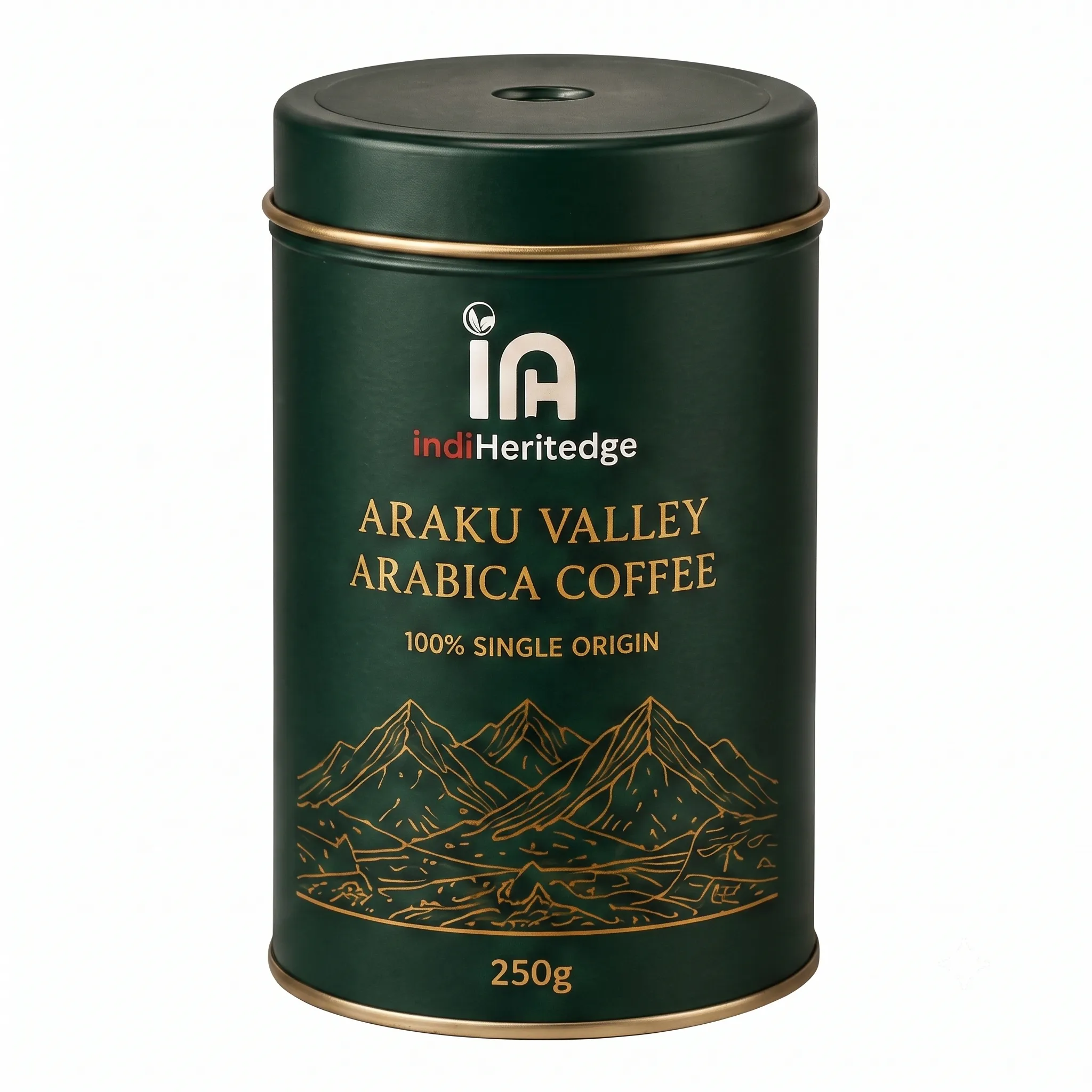
Araku Valley Arabica is a high-altitude Arabica coffee cultivated in the Eastern Ghats by tribal communities using traditional shade-grown and organic cultivation practices. Grown at elevations of approximately 900–1100 metres, it is known for its medium body, citrus flavour, spicy undertones and complex aroma.
Overview
Araku Valley Arabica is an Arabica coffee cultivated in the hilly Eastern Ghats of Andhra Pradesh and Odisha. The coffee is grown primarily by tribal communities under natural forest shade at elevations of 900–1100 metres. Its distinctive growing environment contributes to its characteristic flavour and aroma profile.
Historical Background
Coffee cultivation in the region has a history dating back to the nineteenth century. Historical records identify an early coffee estate established by the Raja of Vizianagaram at Anantagiri in 1863. Coffee cultivation subsequently expanded through the Araku and Ananthagiri areas. In Koraput, Odisha, Maharaja Bikram Dev Barma introduced coffee cultivation in 1930. Government and tribal-development programmes later contributed to the expansion of coffee cultivation in the region.
What Makes It Unique
Araku Valley Arabica is distinguished by its high-altitude cultivation, natural forest shade and traditional organic farming practices. The coffee has a medium body with medium to sharp acidity, citrus flavour and a complex aroma with spicy undertones. The coffee plants are cultivated as an under-crop within the forest ecosystem, creating a distinctive growing environment.
Production Process
Cultivation begins with establishing native shade trees and preparing seedlings in nurseries. The plants are maintained using organic manures, green manuring and biological pest-management practices rather than synthetic fertilizers and pesticides. Ripe red coffee cherries are manually harvested between October and February. The cherries are then pulped, washed, fermented and sun-dried before the processed coffee is sent to markets or processing units.
Geographical Region
The GI area covers specified regions of Andhra Pradesh and Odisha. In Andhra Pradesh, the area includes Visakhapatnam district and mandals such as Araku, Ananthagiri, Paderu, Pedabayalu, Munchingput and others. In Odisha, the primary region is Koraput, with additional areas in Kandhamal, Rayagada, Keonjhar, Gajapati and Kalahandi. The coffee-growing areas are located in the Eastern Ghats at approximately 900–1100 metres above sea level.
Benefits & Uses
The cultivation of Araku coffee has contributed to tribal livelihoods and community-based economic development. Coffee cultivation was also introduced as an alternative to shifting cultivation and as a means of supporting soil conservation. Training programmes and development initiatives have helped farmers improve cultivation and post-harvest practices.
Cultural Significance
Coffee cultivation has become an important part of the economic and agricultural life of tribal communities in the Araku region. Traditional organic cultivation practices are passed between generations, while coffee provides an important source of income for farming families. The crop has also become associated with sustainable tribal development and the region's emerging coffee-tourism identity.
Shop Araku Valley Arabica
1 GI-certified product
Geographical Indication
Reg. 334 · Govt. of India certified